
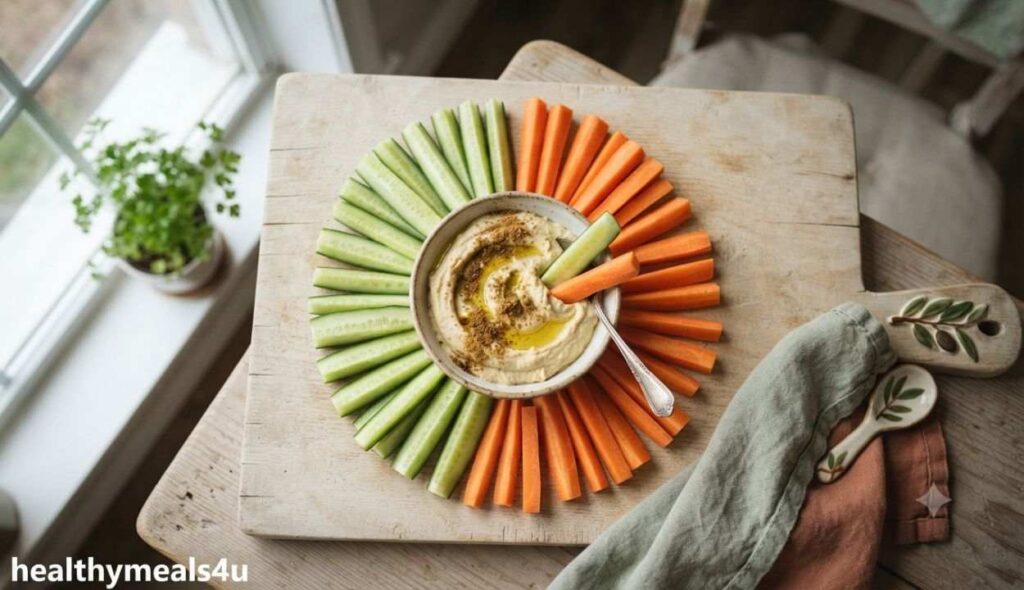
Quick answer: Cucumber and carrot sticks dipped in chickpea hummus are a low-glycaemic-index (GI) snack suited to diabetics and anyone watching blood sugar. A typical serving (1 cup mixed sticks with ¼ cup hummus) has around 130–160 calories, 5–7 g protein and 4–6 g fibre, and keeps blood sugar steadier than most packaged snacks.
I didn’t set out to invent a “diabetic snack”. Nobody sits down and decides to do that. Mine happened by accident, the way most kitchen habits do. My evenings kept ending the same way — a 4 pm slump, the fridge door open a beat too long, me standing there weighing something fried against something sensible. Sensible loss. Almost every time. So one Sunday, more out of stubbornness than any real willpower, I cut a whole box of carrots into sticks and shoved them in the fridge, right at eye level, so I’d see them before I saw anything else. Cucumber joined a few weeks after that, and not for any noble reason either — I’d run out of carrots on a Wednesday and couldn’t be bothered walking to the shop in the heat.
It stuck. That’s the bit I didn’t see coming. Now it’s the first thing I bring up when someone tells me their fasting number’s been all over the place and they want something to snack on that won’t undo their morning walk.
This one covers why cucumber and carrot sticks with hummus actually hold up together, how I make the vegetable hummus, and the mistakes that got me here — so you can skip a few of them.
What Is Cucumber and Carrot Sticks with Hummus?
Not much to it, if I’m honest. Raw cucumber and carrot cut into sticks, dipped into a thick blend of chickpeas, tahini, lemon and garlic. In the UK or the US this barely counts as a recipe — it’s the sort of thing that turns up in a lunchbox without anyone commenting on it. In Indian kitchens it’s newer, and it’s been quietly pushing the evening pakora out of a lot of homes, mine included, though I’ll still make an exception for a pakora on a proper rainy day. Some things don’t need defending. This is what I reach for the other six days of the week, and it sits comfortably alongside the rest of my diabetic-friendly evening snacks rotation.
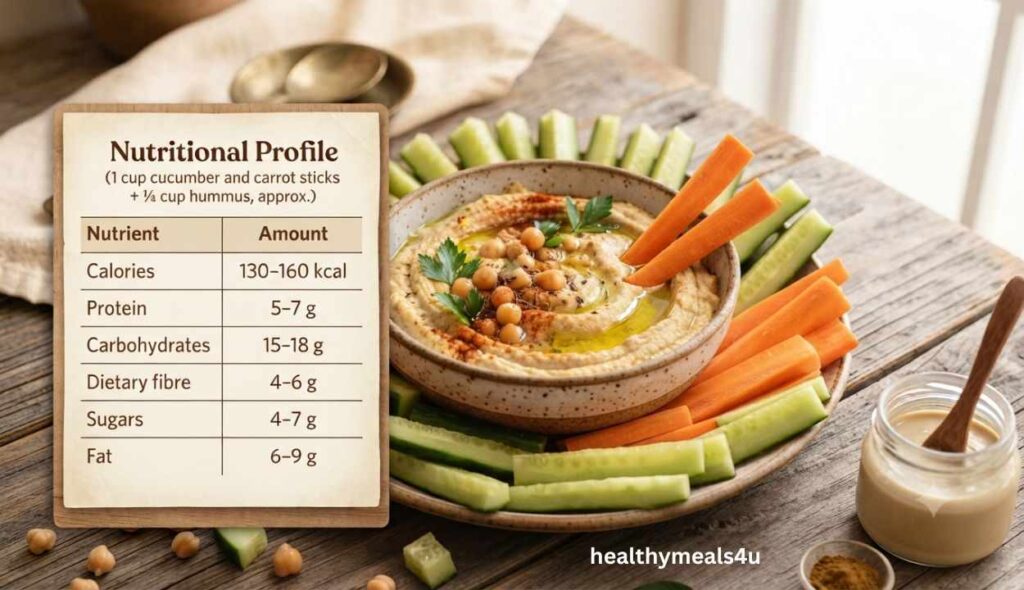
Nutritional profile (1 cup cucumber and carrot sticks + ¼ cup hummus, approx.):
Nutrient | Amount |
Calories | 130–160 kcal |
Protein | 5–7 g |
Carbohydrates | 15–18 g |
Dietary fibre | 4–6 g |
Sugars | 4–7 g |
Fat | 6–9 g |
These numbers shift depending on your hand with the tahini jar. Mine is heavy; it always has been. I’ve decided a thin, watery hummus is basically a failed hummus, so I lean generously and just accept the extra ten calories that come with it. Even with that wobble built in, the shape stays the same — low calorie, real fibre, and enough protein that it counts as more than idle chewing at the fridge door.
Carrot Sticks
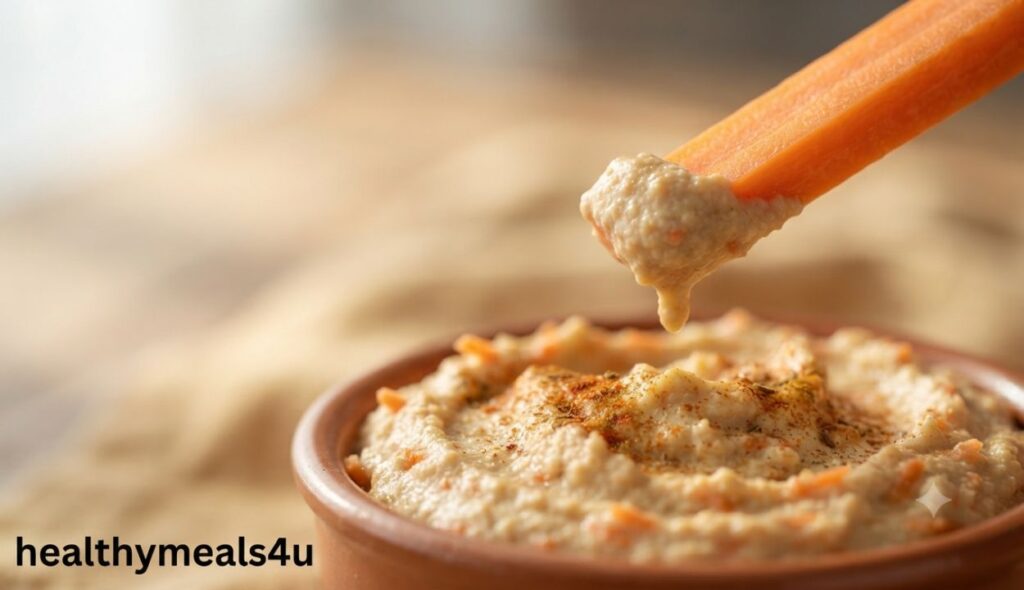
What is the glycaemic index of raw carrots?
Raw carrots land in the low-GI range, but don’t expect a tidy single number — most tables put it anywhere from 16 to around 40, depending on the study and, apparently, the carrot. That’s a wider spread than I’d like to quote with a straight face, but the direction never changes: cooking pushes the number up, so raw wins. It’s also less work, which I’ll admit weighs more heavily on my decisions than it probably should.
GI by itself can mislead you, though. Glycaemic load (GL) is what actually matters day to day, because it accounts for how much carbohydrate you’re eating in real terms, not just how fast it hits. A medium carrot has maybe 4–6g of carbs in the whole thing. You’d have to get through an unreasonable pile of sticks — more than any sane person eats in one sitting — before your blood sugar noticed.
How many carrot sticks make one serving?
Roughly 4–6 medium sticks, cut from 1–2 carrots. I’ve never once measured this out with a scale. Two carrots, split with whatever cucumbers are in the crisper drawer, plus a decent spoonful of hummus — that’s been my system for years, and it’s never once failed me.
Is cucumber lower GI than carrot?
Yes, by a fair margin. Cucumber sits at around 15, one of the lowest values you’ll find for anything you’d actually eat as a vegetable, mostly because it’s roughly 96% water with under 4g of carbohydrate per 100g. There’s barely anything in there for your blood sugar to react to. Carrots are still low-GI, but they carry more carbohydrates and a wider range depending on where you look it up. Put the two side by side, and there’s a practical payoff too — cucumber gives you the crunch and bulk, carrot brings a bit of natural sweetness, and that orange flash of colour makes the plate look like you tried it. Neither does the other’s job on its own.
Carrot Sticks and Hummus: Why This Combination Suits Diabetics?
This isn’t just a pairing that photographs well. There’s actual research behind it, and I only went digging for it after enough people asked me, half-suspicious, “Does it actually work or does it just sound healthy?” Fair question, honestly — a lot of “diabetic-friendly” claims online don’t survive much scrutiny. A dose-response study in the Nutrition Journal measured the glycaemic and insulin index of hummus directly and found both came in significantly lower than white bread. The postprandial glucose response to hummus was roughly four times lower than to white bread, and it didn’t push insulin up to compensate either. Chickpeas doing exactly what pulses are meant to do.
Here’s what’s actually happening on your plate, as best I understand it:
- Fibre from the vegetables slows everything down, so glucose doesn’t arrive all in one rush.
- Protein from the chickpeas keeps you full — no second trip to the fridge twenty minutes later, which, let’s be honest, is the whole point of eating this instead of biscuits.
- Fat from the tahini and olive oil blunts the blood sugar response a bit further still.
- Overall carb load stays low, even when you’re not being fussy about portions.
- No added sugar, no refined flour — rarer than it should be in anything with “healthy” printed on the packet.
The ICMR-NIN Dietary Guidelines for Indians recommend that vegetables and fruit fill roughly half your plate, and this is exactly the sort of low-load, high-fibre food that recommendation has in mind. A snack built almost entirely from raw vegetables and pulses ticks that box without you having to think twice about it.
If your fasting reading has been creeping up lately, and you’re tired of the “what am I even allowed to eat” spiral that comes with it, this is one answer that doesn’t feel like a punishment. I won’t oversell it. It’s not thrilling. It never will be, and I’d rather say that upfront than pretend a carrot stick is going to change your life. But it does its job quietly and quietly beats most of the “diabetic-friendly” recipes floating around that read like nobody who wrote them has ever actually had to manage a fasting number themselves. That’s my one real gripe with this whole corner of the internet, and I’ll happily die on that hill.
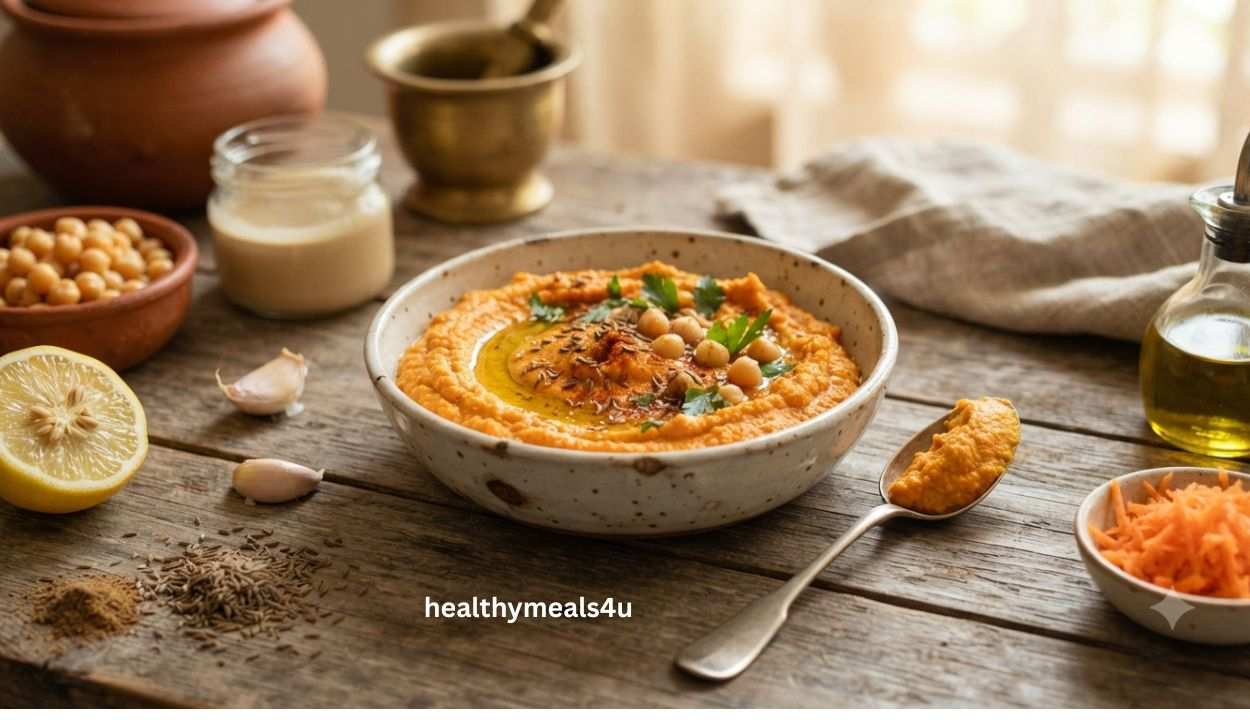
Vegetable Hummus
- Drain and rinse the chickpeas thoroughly if you're using canned ones. Don't skip this — the tinned liquid carries more sodium than you'd guess, and honestly, it changes the smell of the whole batch if you leave it in.
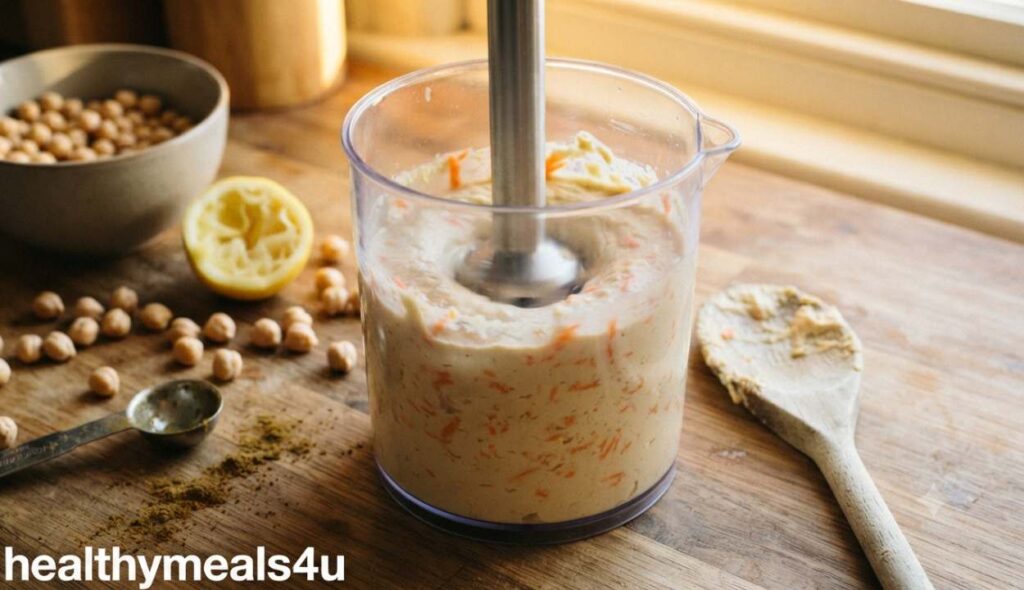
- Blend the chickpeas, tahini, lemon juice, and garlic together. It clumps up thick and stubborn at first, almost like it's refusing to cooperate. Don't panic and don't add water yet. Keep the blender going. It evens out.
- Add water a tablespoon at a time, blending between each addition, until it smooths into something you'd actually want to eat. This step doesn't reward rushing.
- Stir in the cumin and salt, taste, and adjust. It always wants more lemon than you think it will. Always. I've stopped being surprised by this.
- For the vegetable version, fold in the grated carrot right at the end — extra fibre, a nice fleck of colour running through it, and a faint sweetness the plain version just doesn't have.
- Store in an airtight container in the fridge for 5–7 days.
Shop hummus is fine in a pinch — I’m not going to pretend I’ve never bought a tub. But a lot of them carry more salt than you’d want or swap in sunflower oil where olive oil should be, and that swap is not subtle. You taste it the second it hits your tongue, a sort of flatness that olive oil just doesn’t have. Homemade takes about ten minutes, longer on the days your chickpeas decide to be difficult, and you control the salt entirely — which matters more than people assume, especially if sodium’s already on your radar. If you’re building out a small rotation of chickpea and legume-based snacks, my moong sprouts chaat and roasted chana are two more that hold up the same way.
The mistake I still wince about: the first time, I poured all the water in together, thinking I’d save myself a step. What I got was closer to a sauce than a hummus. It ran straight off the cucumber stick and pooled on the plate instead of clinging to anything, and my sister, who’d asked for this specifically, gave me a look I still remember. Go slow with the water. You can always add more. You cannot take it back out, no matter how long you stand there stirring and hoping the blender will fix your mistake for you.
A Kerala-Style Variation of Vegetable Hummus
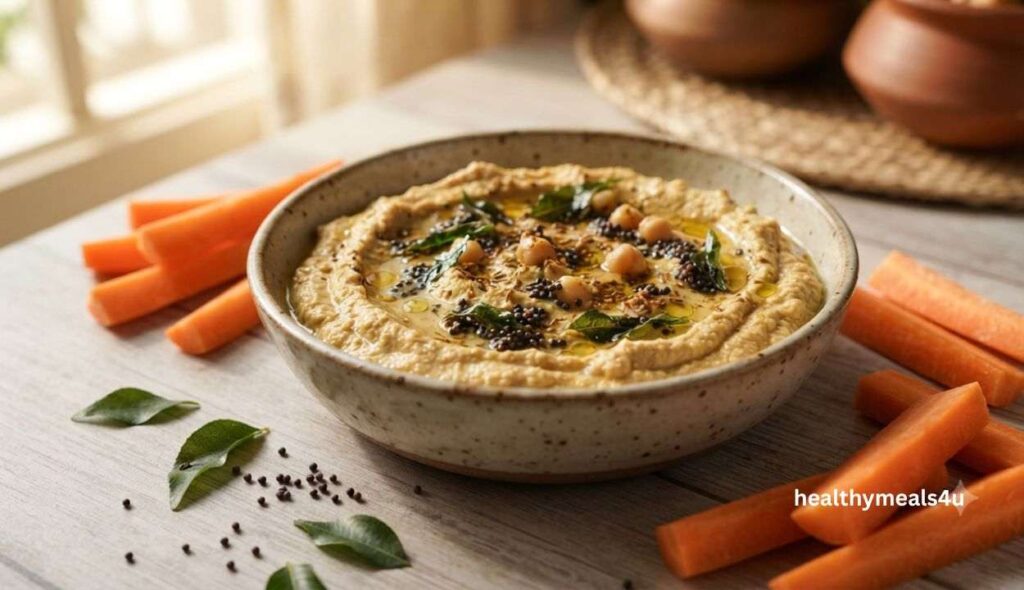
Being from Kerala, I have never once left a recipe exactly as it was given to me. Might be a personality flaw at this point — I’ve stopped fighting it. Sometimes I finish the hummus with a light tadka: mustard seeds, a few curry leaves, and a pinch of asafoetida bloomed fast in hot oil and spooned over just before serving. Nothing about this is traditional, and a hummus purist somewhere would have strong opinions about it. But it tastes like home to me, and these days my family reaches for this version over the plain one more often than not — the same way they’ve come around to my chickpea salad on the nights a dip doesn’t feel like enough.
Cucumber and Carrot Sticks with Hummus vs Other Common Snacks
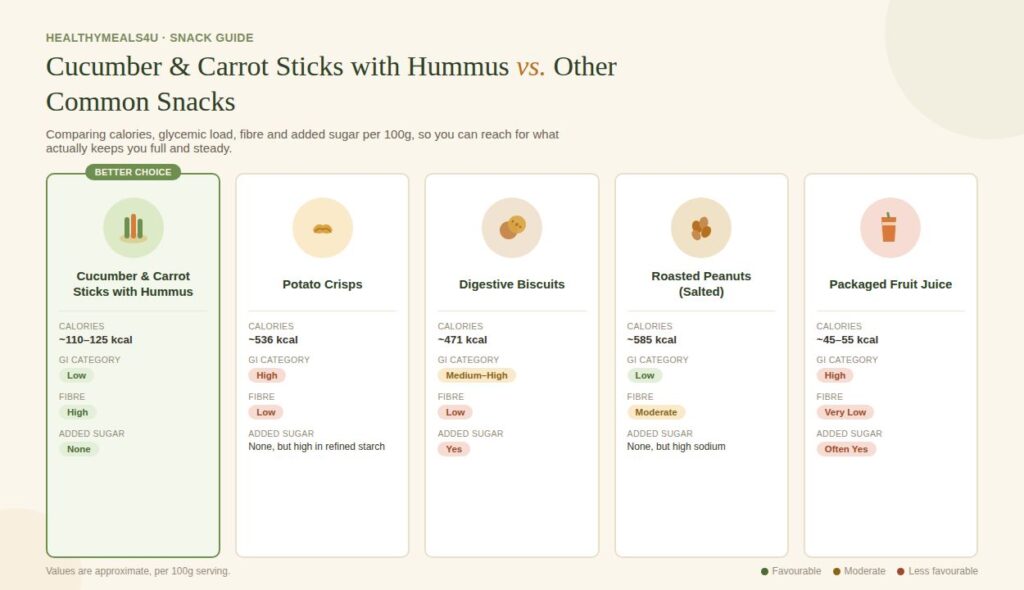
The peanuts always catch people off guard. They’ve got this reputation as the “smart” snack, and calorie for calorie, they’re really not — not if weight is part of what you’re juggling alongside your blood sugar. Cucumber and carrot sticks with hummus wins on nearly every column here: lowest calorie density, real fibre, nothing sneaked in. It’s not glamorous. I’m not going to dress it up as something it isn’t. But it earns its spot more honestly than most things sold as “healthy” on a supermarket shelf, and that’s really all I’m asking of a snack these days.
How to Store Cucumber and Carrot Sticks and Hummus?
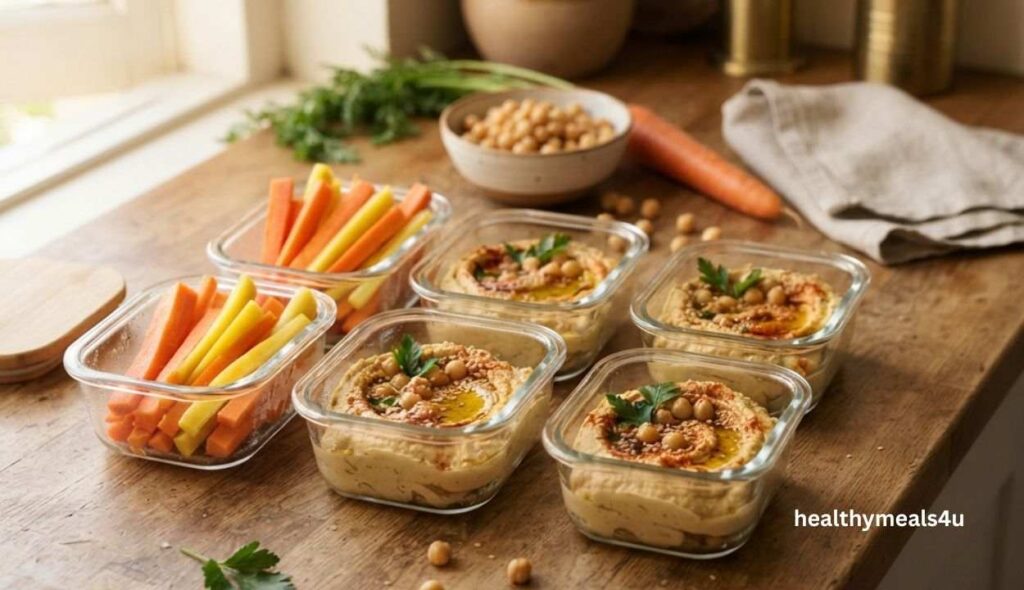
- Vegetable sticks: Airtight container with a damp paper towel in the fridge — cucumber holds up for about 4–5 days before it starts to go a bit soft; carrot lasts longer, closer to 5–6 days.
- Hummus: 5–7 days, sealed, in the fridge. A thin layer of olive oil on top seems to buy it a little extra time, though I couldn’t tell you exactly why — just something I’ve noticed over the years and never bothered to look it up.
- Freezing: Hummus freezes well for up to a month. Cucumber and carrot sticks don’t — they thaw out limp and a bit sad-looking, so just cut fresh ones instead of bothering.
- Meal-prep tip: I do this on Sunday evenings, small containers lined up on the counter, usually while something else needs an occasional stir on the stove. Fifteen minutes, and it keeps me out of the biscuit tin for the rest of the week.
This snack earned its place in my kitchen the slow way — by being useful often enough that it stopped being a decision and just became a habit I didn’t notice forming. If you’re managing diabetes, watching your weight, or you simply don’t want to feel wrecked an hour after snacking, it’s worth keeping stocked, right alongside a proper low-GI breakfast to start the day the same way. Try the homemade vegetable hummus above. And if you end up trying the Kerala-style tempering, let me know how it goes for you—I’m still not entirely sure if it’s a Kerala thing or if it would win people over anywhere.
This article is for general nutritional information and does not replace personalised medical advice. If you’re managing diabetes or another health condition, please check with your doctor or dietitian before making significant dietary changes.
Frequently Asked Questions
1. Is hummus good for diabetics?
Yes. Chickpeas carry a low glycaemic index and slow how fast carbohydrates reach your bloodstream. The research backs it up too — a much gentler blood sugar and insulin response than something like white bread.
2. Are cucumber and carrot sticks with hummus healthy?
Yes, as long as the hummus is homemade or you’ve picked a low-salt, no-added-sugar version off the shelf. You get fibre, plant protein and decent fats without much calorie cost, and it fits comfortably into most diets, diabetic and low-GI included.
3. What can I use instead of tahini in hummus?
Peanut butter in a pinch, a spoon of plain yoghurt, or a bit more olive oil. The flavour shifts slightly each time, but none of them will ruin the batch.
4. Can I eat cucumber and carrot sticks with hummus every day?
For most people, yes — it’s whole food, nothing added. If sodium’s a particular worry for you, check the salt content on shop-bought hummus, or just make your own and skip the guesswork.
5. Is cucumber good for diabetes?
Yes. It sits at around 15 on the glycaemic index, one of the lowest going, and it’s over 95% water, so even a generous portion barely registers with your blood sugar.