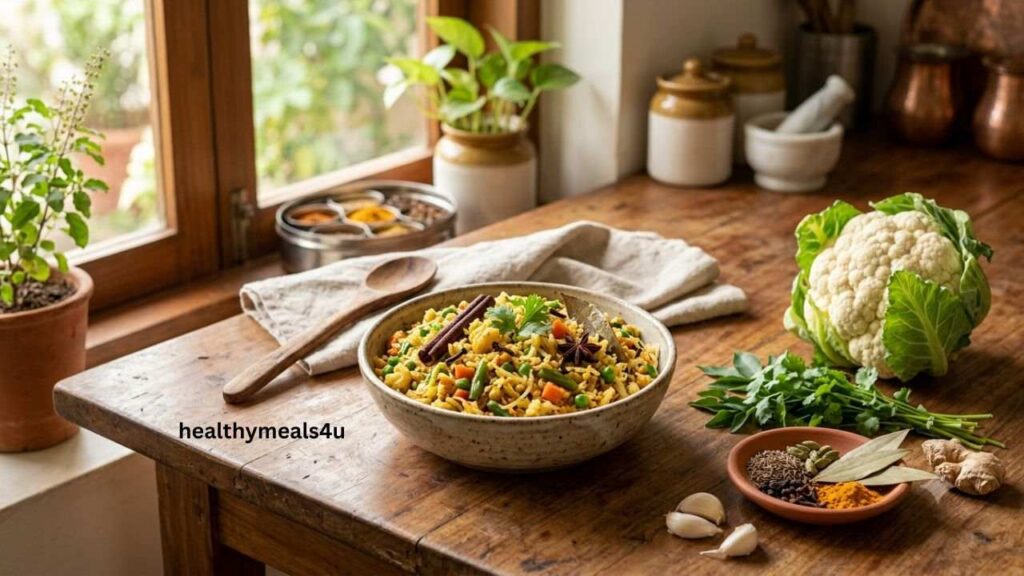
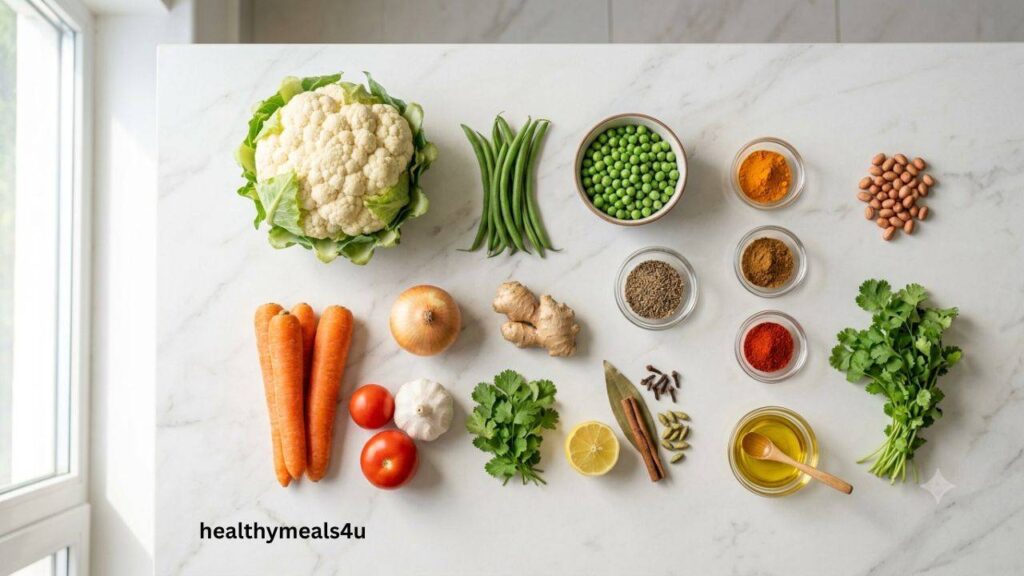
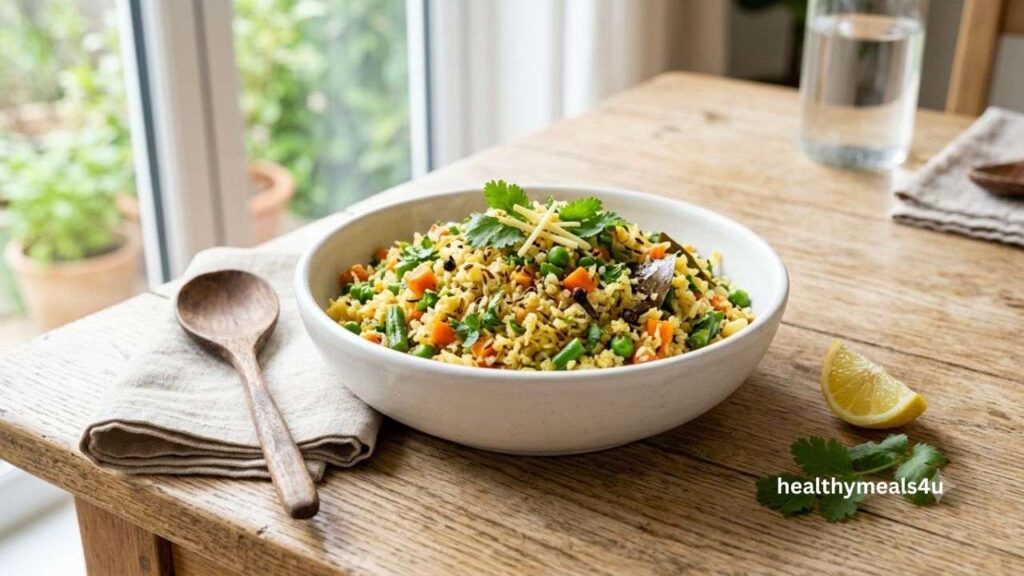
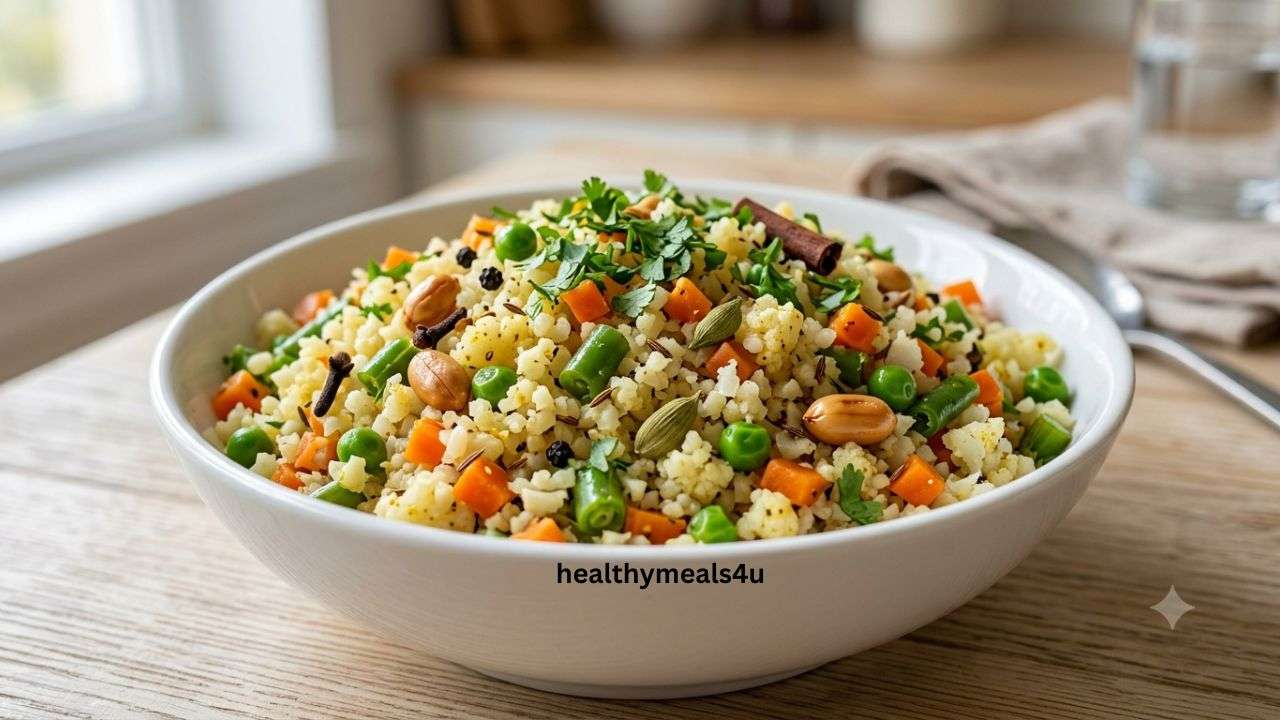
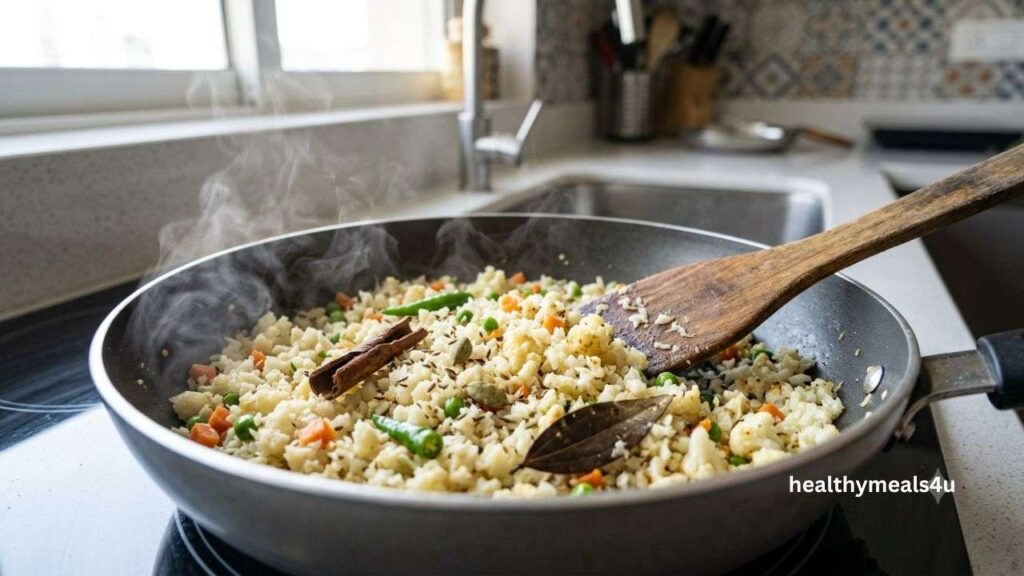
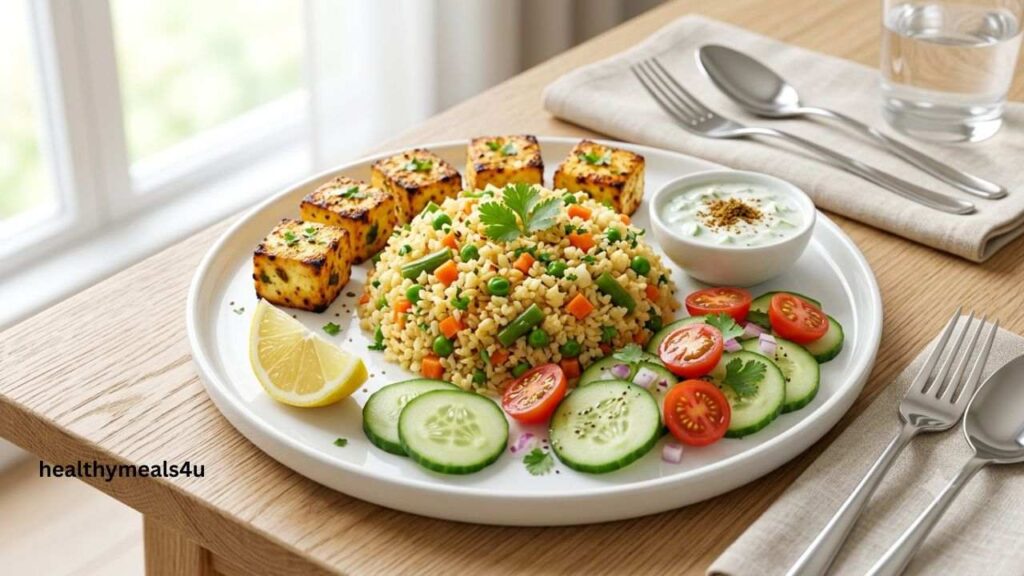
Cauliflower rice pulao is, at its heart, an ordinary Indian pulao with the rice quietly taken out of the equation. Grated cauliflower steps in instead, cooked with the same whole spices, onion, ginger-garlic and mixed vegetables you’d use anyway. Do the maths, and a bowl comes to around 120-150 calories and 10-12 g net carbs, against 45 g or more for actual rice. The glycaemic index is very low; it’s on the table in under 35 minutes, and most people can’t actually tell until someone points it out.
I started making this for my mother about two years after she was diagnosed with type 2 diabetes. We tried a couple of Indian dinner recipes for diabetics. Rice was the thing she missed most at dinner, and every “healthy pulao” I found online was either bland or turned to mush. What fixed it, in the end, came down to two small things: grating the cauliflower by hand rather than using a food processor and cooking it fast on high heat instead of letting it sit and simmer. That’s the version below, and it’s still what we eat two years on.
What Is Cauliflower Rice Pulao?
Take an ordinary Indian pulao and swap the rice, partly or completely, for finely grated or riced cauliflower. That’s really the whole idea. Everything else about the cooking stays the same: whole spices go into hot oil, onions and ginger-garlic get sautéed until they smell right, vegetables go in, and the whole thing finishes quickly enough to stay fluffy rather than collapsing into a wet mess.
Cauliflower sits in the cruciferous family alongside broccoli, cabbage and Brussels sprouts. It’s naturally low in carbs and calories and carries a decent amount of fibre, vitamin C and vitamin K. That’s why it’s become such a common rice substitute in low-carb and diabetic kitchens well beyond India.
Nutrition Facts of Cauliflower Rice Pulao
A single serving of cauliflower rice pulao – around 1.5 cups – works out to roughly 120-150 calories, 10-12 grams net carbs, 4-5 g protein, 5-7 g fat and 3-4 g fibre, with an estimated glycaemic index of 15-20. Those numbers shift slightly depending on how much oil, nuts or paneer end up in the pan.
Cauliflower Rice vs White Rice vs Brown Rice (per 1 cup, cooked)
Nutrient | Cauliflower Rice | White Rice | Brown Rice |
Calories | ~25-30 kcal | ~200-205 kcal | ~215-220 kcal |
Carbohydrates | ~5 g | ~44-45 g | ~45 g |
Fibre | ~2-3 g | ~0.6 g | ~3.5 g |
Protein | ~2 g | ~4 g | ~5 g |
Glycemic Index (approx.) | 15 | 70-89 (varies by type) | 50-68 |
Glycemic Load (approx., per serving) | 1-2 | 20-26 | 15-19 |
These GI figures move around depending on the rice variety, how ripe it was, and how it’s cooked — and different databases don’t always agree with each other either. Treat them as rough reference points, not fixed medical data.
Why Glycaemic Load Matters More Than Glycaemic Index Alone?
GI tells you how fast a food raises blood sugar. GL takes that figure and weighs it against how much of the food you’re actually eating in a real portion. A food can have a high GI and still land a low GL, simply because the serving is small. Rice tends to score high on both counts, mostly because people rarely eat small portions of it. Cauliflower scores low on both, which is really the whole reason swapping it in makes more of a real-world difference than the GI number alone would suggest.
Benefits of Cauliflower Rice Pulao
Strip away the marketing, and the benefit is fairly simple: you’re swapping out a high-carb staple for a non-starchy vegetable without losing the flavour of something that already feels like home cooking. A few ways that plays out in practice:
Rice sits high on the glycaemic index, somewhere between 70 and 89 depending on the type, while cauliflower comes in at roughly 15. That gap alone means blood sugar rises far more gently after a meal. Fibre matters here too — a cup of cooked cauliflower has close to 3 g, against under half a gram in the same amount of white rice, and fibre is what slows glucose from hitting the bloodstream too quickly. Then there’s the calorie side: a much lower count per portion, which helps with weight management, and weight management feeds fairly directly into insulin sensitivity for anyone living with type 2 diabetes. It’s also naturally gluten-free and stays reasonably light on saturated fat as long as you don’t get heavy-handed with the oil.
The part that’s easy to miss: it still tastes like the dish it’s replacing. That matters more than most nutrition advice lets on. Diets that feel like punishment rarely survive contact with real life — the ones people actually stick with are usually the ones that still taste like something they’d choose to eat anyway.
Worth being upfront about what this isn’t, though — it’s not medicine, and it won’t reverse anyone’s diabetes on its own. Think of it as one useful swap within a bigger routine that still includes whatever medication, activity and monitoring a doctor has recommended.
Who Should Eat This Cauliflower Rice Pulao?
This is a good fit if you’re managing type 2 diabetes or prediabetes and trying to bring down carbs at dinner; following a low-carb or keto-style way of eating; trying to get more vegetables in without it feeling like a chore; watching your weight; or eating gluten-free — there’s no wheat or grain anywhere in this recipe.
Who Should Avoid Cauliflower Rice Pulao (or Eat It Carefully)?
A few groups worth a second thought here. If you have IBS or a FODMAP sensitivity, it’s worth knowing cauliflower sits high on the FODMAP scale and can bring on bloating, gas or cramping for some people — smaller, well-cooked portions tend to sit easier than raw or large ones. If you have a thyroid condition, particularly untreated hypothyroidism, cauliflower contains goitrogenic compounds that can, in large raw amounts, interfere with iodine uptake; cooking cuts that effect down considerably, and ordinary portions are fine for most people, but it’s worth flagging to a doctor if thyroid health is already a concern.
If you’re prone to oxalate-related kidney stones, cauliflower carries a moderate oxalate load, so portion size matters if that’s ever been an issue for you. And if you need more calories or carbohydrates than most – underweight, a growing child, training hard – you’re probably better off treating this as a partial swap, something like 50:50 with regular or brown rice, rather than cutting the rice entirely.
None of this is medical advice, just general nutrition information. Anyone with a diagnosed condition should run any significant dietary changes past a doctor or registered dietitian first.
Practical Tips From My Kitchen
If you’re using a food processor, squeeze the water out before cooking — processed cauliflower rice holds onto more moisture than hand-grated does, so wrapping it in a kitchen towel and giving it a squeeze makes a real difference. Don’t skip the pre-sauté either. It’s tempting to throw everything into the pan at once, and it’ll technically still cook, but the texture is noticeably better when the cauliflower rice gets dry-sautéed on its own first. Frozen cauliflower rice works fine too — just thaw and drain it properly, since it lets go of a surprising amount of water as it defrosts. Adding a protein — paneer, boiled chickpeas, boiled eggs, or grilled chicken — turns this from a side dish into an actual dinner and slows carb absorption down further in the process. And if you cook this often enough, grating a big batch of cauliflower ahead of time and freezing it in portions cuts prep down to almost nothing on the nights you don’t feel like starting from scratch.
Common Mistakes
Mistake | Why It Happens | Fix |
Mushy, watery pulao | Skipping the pre-sauté or cooking on low heat too long | Dry-sauté the cauliflower rice first, then finish on high heat in under 4 minutes |
Bland flavour | Under-salting, or skipping the whole spices, | Temper whole spices in oil first; taste and adjust salt at the end |
Mashed, over-processed texture | Over-pulsing in the food processor | Pulse in short bursts, checking the texture as you go |
Bitter aftertaste | Overcooking, or using an older head of cauliflower | Use fresh cauliflower, and don’t cook past 4-5 minutes once it’s added |
Doesn’t feel like a full meal | Treating it as a standalone vegetable dish | Add paneer, legumes, egg, or a lean protein alongside it |
Cauliflower Rice Pulao Variations and Alternatives
Variation | Best For | Notes |
50:50 cauliflower + brown rice pulao | Wanting some traditional texture plus more calories | Roughly halves the carbs of a regular pulao while keeping some actual rice bite |
Broccoli rice pulao | Not keen on cauliflower’s smell | A bit more earthy, similar low-carb numbers |
Cabbage rice pulao | Budget-friendly, available year-round | Slightly higher natural sugars than cauliflower, still low-GI |
Quinoa pulao | Needing more protein and steadier energy | Higher carbs than cauliflower rice, but a complete protein with a moderate GI |
Foxtail millet pulao | Wanting a traditional grain that beats white rice | Millets are increasingly recommended in Indian diabetic diets for fibre and slower digestion |
Expert Recommendations
Dietary guidance from ICMR-NIN in India generally calls for half the plate to be non-starchy vegetables, with refined grains kept modest — especially for anyone managing diabetes. That lines up closely with what the American Diabetes Association recommends too: lean on non-starchy vegetables, keep an eye on portions of carb-heavy foods, and pair carbs with protein and fibre to soften the blood sugar response. Cauliflower rice pulao is really just one practical way to bring that “diabetic plate” idea to an ordinary Indian dinner without having to weigh out every gram of carbohydrate.
It’s worth saying, though; everyone responds to food a little differently. Some people with diabetes manage a moderate portion of regular rice pulao just fine within their overall carb allowance, especially once medication and activity are factored in. This cauliflower rice pulao recipe is a useful tool, not a rule everyone has to follow, and checking your own blood glucose remains the most reliable way to know how any specific meal actually affects you.