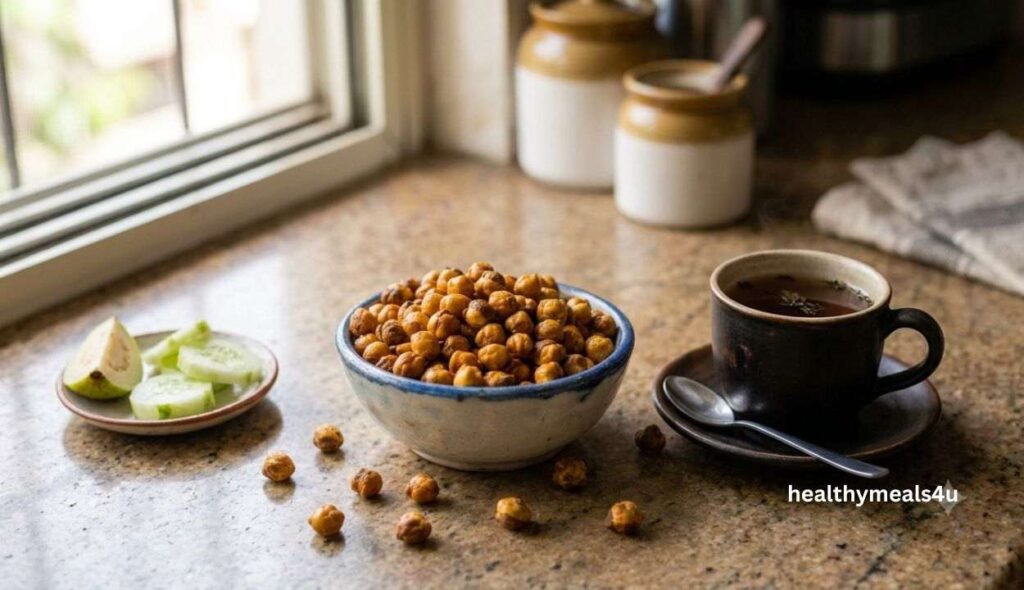
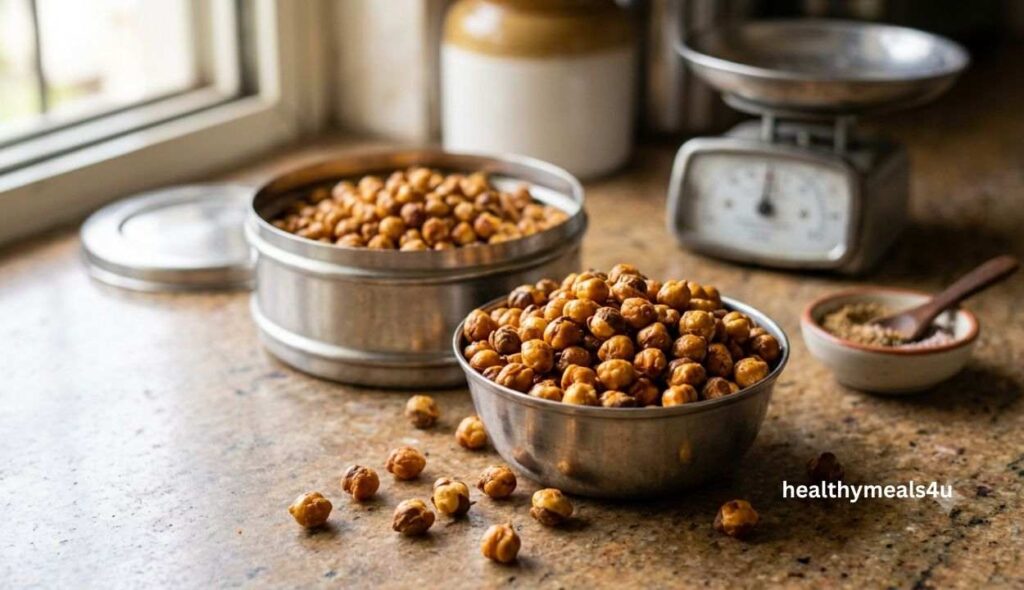
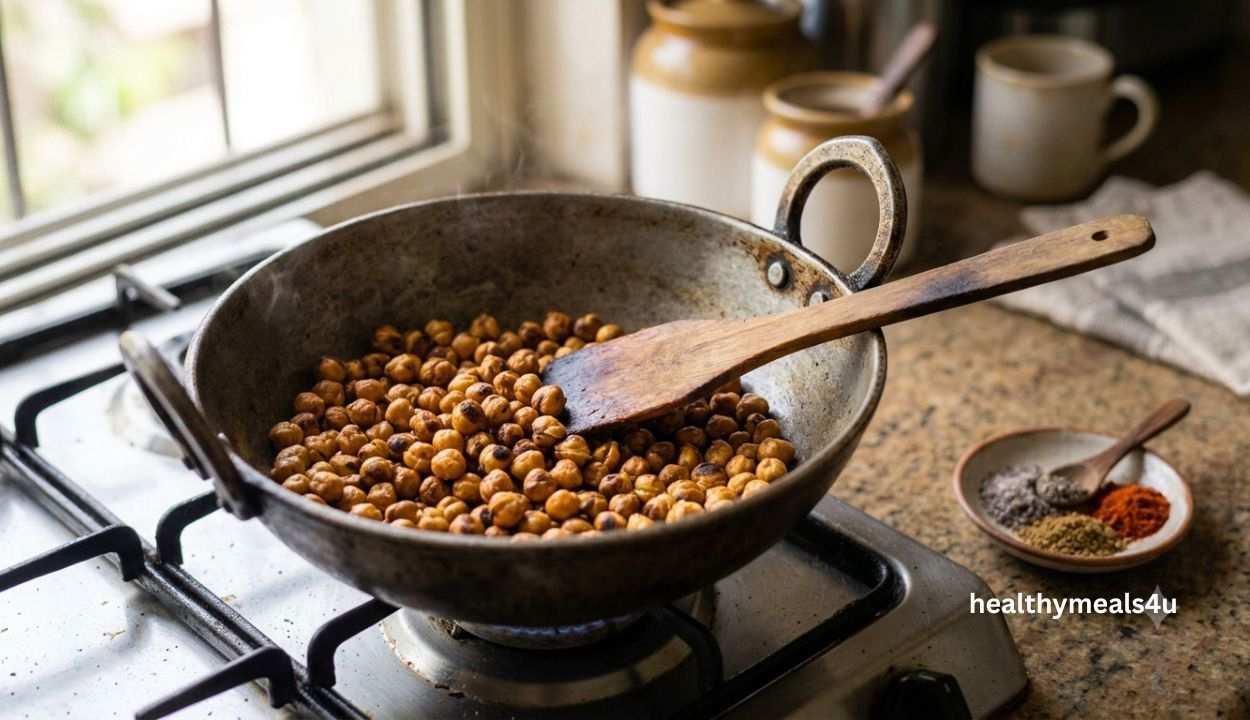
There’s a steel jar of roasted chana on my counter right now. Half empty. It’s been sitting there for four days, which in my house is basically a record — usually the thing is gone in two. I keep going back to it. Not because it’s “healthy” in that vague, guilt-relieving way every snack claims to be these days, but because it does the one job I need it to do. It’s cheap, it needs no fridge, and it keeps me out of the biscuit tin around 4pm, which honestly is the whole battle most evenings.
And here’s what actually annoys me about this snack: nobody agrees on the protein number. I’ve seen 18 grams quoted. I’ve seen 25. One blog — I wish I were exaggerating — said 30 grams per 100 g, which just isn’t true for chana, not even close. So I stopped trusting whatever the internet was repeating to itself and sat down with the ICMR Indian Food Composition Tables instead to see what’s actually real. You shouldn’t have to wade through five different “facts” just to know what’s in your own snack jar.
Quick Answer: Roasted Chana Nutrition Per 100g
Nutrient | Per 100g (approx.) | Per 30g handful |
Calories | 270–390 kcal | 80–115 kcal |
Protein | 18–22g | 5.5–6.5g |
Fibre | 11–18g | 3–5g |
Carbohydrates | 55–62g | 16–19g |
Fat | 5–7g | 1.5–2g |
Before you screenshot this and treat it like gospel — don’t. These numbers are compiled averages, pulled from published data and ICMR-IFCT reference tables, not a reading off one specific packet sitting on your kitchen shelf. The chana variety, how long it sat in the pan, whether the husk stayed on — all of it nudges the number one way or the other. I found this out the annoying way. Two batches, same recipe, same weight of raw chana, roasted on two separate evenings — and they came out different enough in crunch and final weight that I actually re-weighed both, twice, convinced I’d made a mistake somewhere. I hadn’t. That’s just dried pulses being dried pulses. If you want an exact figure and not a reasonable range, read the label on your specific brand.
Protein in Roasted Chana: Why the Number Matters?
At roughly 18–22g protein per 100g, roasted chana sits close to paneer, and it beats boiled dal or plain boiled chana by a decent margin, gram for gram. That’s really the whole reason this snack keeps turning up on every vegetarian protein list going around online — it’s one of the few plant snacks that gets you a real, usable protein number without needing to sit down and eat a full plate of it.
Think in portions you’d actually eat, not the 100g on the label. A 30g handful — roughly what fits in a small katori, the kind you’d use for chutney, not the rice-serving one — gets you close to 6g of protein for under 100 calories. Put that next to whatever namkeen is sitting on the shelf beside it, and honestly, it’s not even close. This is also why chana shows up in my diabetic-friendly evening snacks roundup alongside makhana and moong sprouts. Protein and fibre together slow down how fast a snack moves through your blood sugar, and evenings specifically are when that slower digestion actually matters — not mid-morning, not right after a workout.
Roasted Chana Dal vs. Whole Roasted Chana: What's the Difference?
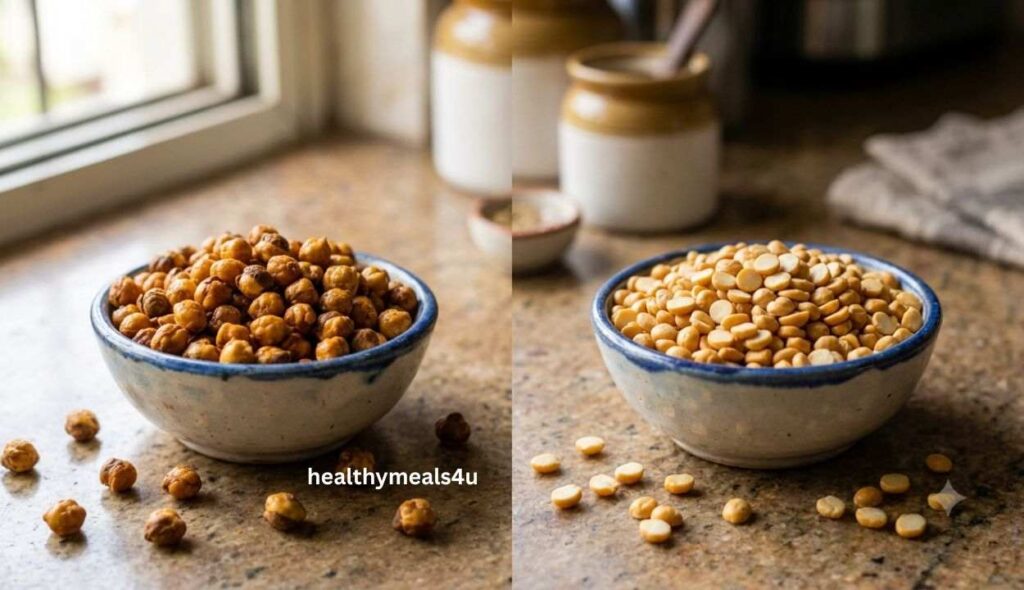
I get asked this often enough that I should print it on a card and hand it out. Roasted chana dal — sold under a few names depending on where you shop, roasted Bengal gram, bhuna chana dal, dalia, take your pick — is chana split and de-husked before it ever touches a roasting pan. Whole roasted chana keeps its skin on, husk and all, more or less the way it grew.
What that actually changes for you, standing in your kitchen deciding which packet to buy:
- Whole roasted chana carries a little more fibre, simply because the husk is still doing its job.
- Roasted chana dal has a smoother bite and grinds down far more easily, which is exactly why it’s the base for sattu, and for that roasted chana chutney powder that somehow always tastes better at your grandmother’s house than anywhere you’ve made it.
- Protein barely differs between the two. One lab-tested figure from ICMR’s Indian Food Composition Tables puts roasted chana dal at 20.8g protein and 11.5g fibre per 100g — right in the middle of the range you’d expect from whole roasted chana too.
So: fibre for blood sugar or digestion, go whole, husk on. Grinding for chutney or sattu, go with the dal — it’s easier on you and, more importantly, on your mixer. Speaking of which, I once tried grinding whole roasted chana, husk and all, because I’d run out of the dal version and couldn’t be bothered to go buy more. Don’t do that. My mixer made a noise I hadn’t heard before and haven’t heard since, and I’m in no hurry to hear it again.
Roasted Chana Benefits
Past the vague “it’s healthy” sticker every snack gets slapped with these days, whether it’s earned it or not, here’s what the protein-and-fibre combination is actually doing on your plate:
- Keeps you full for longer. Protein and fibre slow digestion down together, which is why one small handful holds off hunger better than the same calorie count in biscuits or chips would. I’ve tested this — unscientifically, I’ll admit, but repeatedly — against my own 4pm biscuit habit, and chana wins nearly every time. Nearly.
- Supports steadier blood sugar. Fibre-rich, minimally processed pulses are exactly what ICMR-NIN and ADA dietary guidance point toward for managing diabetes — food that digests slowly instead of spiking sugar fast. If your fasting reading has been creeping up lately and you’re looking for one small, boring change that actually moves the needle, this is it. Not exciting. Just effective.
- A genuinely useful plant protein source. For anyone eating vegetarian or vegan, it’s one of the more calorie-efficient ways to get protein into your day — especially paired with a grain like rice or roti to round out the amino acid profile, something I only started doing on purpose after actually reading up on complementary proteins properly.
- Naturally low in fat. Dry-roasted, not fried, so fat stays in the 5–7 g range per 100 g, and almost all of it is unsaturated.
- Rich in iron, magnesium, and folate. Worth knowing for anyone, but especially useful if your diet leans vegetarian and you keep half an eye on those numbers.
Roasted Chana Calories: How Much Is a Sensible Portion?
Roasted chana calories land around 270–390 kcal per 100g. That number looks alarming the first time you see it — until you remember nobody’s actually sitting down and eating 100 g in one sitting. Here’s the realistic breakdown:
- A small handful (~30g): 80–115 kcal, 5.5–6.5g protein
- A katori (~50g): 135–195 kcal, 9–11g protein
- A full 100 g bag: 270–390 kcal, 18–22 g protein — at this point it’s basically a meal-adjacent portion, not a snack anymore
The mistake I see most often — and yes, one I’ve made plenty of times myself, usually while watching something on my phone and not paying the slightest attention to my own hand — is treating roasted chana like an unlimited snack just because the word “healthy” got attached to it somewhere along the way. It’s dense for its volume. A small handful really is the intended portion, not a starting point you build up from over the course of an evening.